Hello Everyone!
I hope all is well
Another new post on the blog, this time it is on arousal and anexiety. This is a poster presentation converted into a blog post.
The poster was co - produced by myself, Connaugh Pearce and Callum Wilksinson. It was part of our first year foundation psychology module on the Applied Sport Science course.
Hope you enjoy reading it
Like, share and comment!
------------------------------------------------------------------------------------------------------------------------------
**Copyright Disclaimer Under Section 107 of the Copyright Act 1976, allowance is made for 'fair use' for purposes such as criticism, comment, news reporting, teaching, scholarship, and research. Fair use is a use permitted by copyright statute that might otherwise be infringing. Non-profit, educational or personal use tips the balance in favour of fair use**
------------------------------------------------------------------------------------------------------------------------------
Abstract
This
poster presentation attempts to explain how anxiety and arousal affects sports
performance.
It looks at models such as reversal theory, catastrophe theory, and the employing of the CSAI-2 test (competitive state anxiety inventory) in giving a better understanding of mood states (paratelic, telic) on performance, and the state of mind risk athletes and non-risk athletes are in. From each of the three studies investigated, male and female participants were used along with amateur and elite standard athletes.
Athletes found that performers in a paratelic state performed much better than those in the telic state when testing their maximum strength. It was also found that there was a negative relationship between cognitive anxiety and performance in athletes, but a positive relationship between self-confidence and performance.
From this analysis the moderator variables for the cognitive anxiety performance relationship were sex and standard of competition. To conclude, from the studies shown, all of the theories confirmed that arousal and anxiety have a major impact on sports performance.
It looks at models such as reversal theory, catastrophe theory, and the employing of the CSAI-2 test (competitive state anxiety inventory) in giving a better understanding of mood states (paratelic, telic) on performance, and the state of mind risk athletes and non-risk athletes are in. From each of the three studies investigated, male and female participants were used along with amateur and elite standard athletes.
Athletes found that performers in a paratelic state performed much better than those in the telic state when testing their maximum strength. It was also found that there was a negative relationship between cognitive anxiety and performance in athletes, but a positive relationship between self-confidence and performance.
From this analysis the moderator variables for the cognitive anxiety performance relationship were sex and standard of competition. To conclude, from the studies shown, all of the theories confirmed that arousal and anxiety have a major impact on sports performance.
Introduction
The aim of this poster
presentation is to explain the relationship between arousal and anxiety on sports
performance, and study the positive or negative emotional states on performance.
Arousal can be defined as, a
general physiological and psychological activation, varying on a continuum from
deep sleep to intense excitement (Gould, Weinberg, 2011, p.78). Arousal is
viewed as a mixture of psychological and physiological activity in a person,
and can be viewed as a positive aspect of stress. The amount of arousal
experienced by a person can be a motivator to change, whether this is a
performance increase or improved learning of a task. However, too much or too
little of arousal can work against the performer, therefore it is crucial to
reach a mid-point so there is an optimal level achieved.
Anxiety is viewed as a negative emotional state in which feelings of nervousness, worry, and apprehension are associated with activation or high levels of arousal in the body (Gould, Weinberg, 2011). There are different forms of anxiety; trait anxiety is where the person experiences worry and a feeling of nervousness in different situations. These high levels of anxiety experienced by the person are due to their personality.
On the other hand, state anxiety is felt in response to a specific situation; it is anxiety related to a specific mood state (Richard, C, 2002). These two levels of anxiety are linked, as a person with high levels of trait anxiety will also experience high levels of state anxiety. The relevance of these areas of study to athletes is extremely important in enhancing their sporting performance, as it aims to illuminate the relation between anxiety and arousal. This relationship, if fully understood, can help athletes to psych up and perform better, rather than psyching out and performing poorly (Gould, Weinberg, 2011).
Anxiety is viewed as a negative emotional state in which feelings of nervousness, worry, and apprehension are associated with activation or high levels of arousal in the body (Gould, Weinberg, 2011). There are different forms of anxiety; trait anxiety is where the person experiences worry and a feeling of nervousness in different situations. These high levels of anxiety experienced by the person are due to their personality.
On the other hand, state anxiety is felt in response to a specific situation; it is anxiety related to a specific mood state (Richard, C, 2002). These two levels of anxiety are linked, as a person with high levels of trait anxiety will also experience high levels of state anxiety. The relevance of these areas of study to athletes is extremely important in enhancing their sporting performance, as it aims to illuminate the relation between anxiety and arousal. This relationship, if fully understood, can help athletes to psych up and perform better, rather than psyching out and performing poorly (Gould, Weinberg, 2011).
During this presentation the
area being explored will be how arousal can function to the advantage of one
person, but on the other hand have a detrimental effect to another. Also, what
effects do the fluctuations in anxiety levels, within a person, have on
sporting performance?
Article: Arousal
seeking in sports participants
Paratelic and Telic dominance was the key assessor in this
study. The article seeks out to find what state of mind risk athletes and
non-risk athletes are in, Paratelic or telic state of dominance. This would
determine in the end which of the two types of athletes are arousal seekers or
arousal avoiders also. They used the TDS (Telic dominance scale) to conduct and
analyse their results which is a 42 item scale comprised of 3 subscales,
Seriousmindness, planning orientation and arousal avoidance.
Three studies were conducted, the first was 102 Australian Males split into 3 groups, 2 groups doing High-Risk Sport and the remaining group doing a Low-Risk sport, the second study consisted of 56 Dutch Males, again split into 3 groups, 2 HR activity and the remaining LR activity. The final study was one where sporting glider pilots and a controlled group of non-sporting members were used, it was trying to find out how arousal differs in age. The hypothesis was based on the theory named ‘Reversal Theory’.
Three studies were conducted, the first was 102 Australian Males split into 3 groups, 2 groups doing High-Risk Sport and the remaining group doing a Low-Risk sport, the second study consisted of 56 Dutch Males, again split into 3 groups, 2 HR activity and the remaining LR activity. The final study was one where sporting glider pilots and a controlled group of non-sporting members were used, it was trying to find out how arousal differs in age. The hypothesis was based on the theory named ‘Reversal Theory’.
Article: The Effects of Elevated Arousal and Mood on Maximal Strength
Performance in Athletes
The study was looking at the reversal theory research to
see if high arousal levels contribute to inhibited athletic performance. They
used 22 male and 6 female elite level athletes and divided them into paratelic
(non-goal directed and processed focused) and telic groups (goal directed) each
subjected to scripts of these states. Each group whilst listening to their
script will perform a max hand grip test. Guided imagery techniques where sued
to change physiological and psychological arousal levels.
Results showed significant increases in strength when in the paratelic state (high positive arousal) compared to the telic state. Heart rate and other indicators of parasympathetic and sympathetic nervous system were not found to mediate between psychological arousal and performance. They used the following tests, Telic State Measure, Visual Analogue Scale, Tension and Effort Stress Inventory and the Motivational Style Profile Questionnaire.
Results showed significant increases in strength when in the paratelic state (high positive arousal) compared to the telic state. Heart rate and other indicators of parasympathetic and sympathetic nervous system were not found to mediate between psychological arousal and performance. They used the following tests, Telic State Measure, Visual Analogue Scale, Tension and Effort Stress Inventory and the Motivational Style Profile Questionnaire.
Article: The relative impact of cognitive anxiety and self-confidence upon sport
performance: a meta-analysis
During this study the meta
analysis investigated two relationships in competitive sport: 1) state
cognitive anxiety with performance and 2) state self-confidence with
performance. This relationship has been investigated in much detail over a
number of years, with researchers attempting to clarify this with several
models and theories. The study used both male and female participants and
standard of competition they performed at, which gave significant moderating
variables for the relationship between cognitive anxiety and performance.
The studies were conducted through the use of the CSAI-2 (competitive state anxiety inventory) which is the most effective questionnaire for researching the relationship between cognitive anxiety, self-confidence and sport performance. Of the 43 studies reporting a relationship between cognitive anxiety and performance, 60% reported a negative relationship and 23% reported a positive relationship. The same 43 studies also reported a relationship between self-confidence and performance, where 76% reported a positive relationship and 10% reported a negative relationship.
The studies were conducted through the use of the CSAI-2 (competitive state anxiety inventory) which is the most effective questionnaire for researching the relationship between cognitive anxiety, self-confidence and sport performance. Of the 43 studies reporting a relationship between cognitive anxiety and performance, 60% reported a negative relationship and 23% reported a positive relationship. The same 43 studies also reported a relationship between self-confidence and performance, where 76% reported a positive relationship and 10% reported a negative relationship.
Results
The
results taken from all three studies in this article were based on findings and
scores taken from the TDS, (Telic Dominance Scale). From Study 1 results found
that from three of the sports studied, two of them (Surfing & Sailboarding)
had a close relationship, maintaining a fairly low score of 12.28 and 12.61,
while the other in question (Weight Lifting) had a much higher overall score of
Mean 15.68.
From
Study 2, subscales were brought into action where they found that planning
orientation and serious-minded had no significant difference from the three
groups tested. Although from the arousal-avoidance subscale, they found much
lower scores from what they believe to be the ‘high-risk’ sports than those of
the marathon runners. This in turn strongly influenced the overall score for
telic dominance, where the marathon runners scored higher once again than the
risk sport performers.
From
Study 3, glider pilots and a control group of non-sporting participants were
tested. Similar results from study 2 were found in this study where planning
orientation and serious-minded subscales had no significant differences in
order to draw to a final conclusion. Although once again to back-up Study 2,
the glider pilots scored considerably lower on arousal avoidance than the
control group.
The study “The Effects of Elevated Arousal and Mood on
Maximal Strength Performance in Athletes” based its hypothesis on the Reversal
Theory. 28 elite athletes in the experimental group and 28 volunteers in the
control group. The athletes showed greatest handgrip strength performance
following the paratelic induction. This supports the study’s original
hypothesis as well as previous reversal theory research. Two of the three
remaining hypotheses based on reversal research were also supported.
Participants experienced greater levels of anxiety during the telic induction and greater levels of excitement during the paratelic induction. Elite level athletes where more telic dominant than controls was as expected and replicates research (Kerr 1987). Strength was superior when in paratelic state but strength never improved during study. High felt arousal and high hedonic tone was critical for best strength performance.
Participants experienced greater levels of anxiety during the telic induction and greater levels of excitement during the paratelic induction. Elite level athletes where more telic dominant than controls was as expected and replicates research (Kerr 1987). Strength was superior when in paratelic state but strength never improved during study. High felt arousal and high hedonic tone was critical for best strength performance.

From the results conducted in the Woodman and Hardy (2003)
study, it reported a relationship between cognitive anxiety and performance. 26
of the 43 studies reported a negative relationship, 7 reported non-significant
results and 10 reported a positive relationship. Of the studies reporting a relationship between
self-confidence and performance, 32 reported a positive relationship, 6
reported non-significant results and 4 reported a negative relationship. The
cognitive anxiety and self-confidence mean effect sizes were greater for high
standard athletes in comparison to low standard athletes. The possible reason
for this being that high standard level of performance is typically associated
with increased pressure.
Discussion
From the results of the study ‘The Effects of Elevated Arousal
and Mood on Maximal Strength Performance in Athletes’ has found it is clear
that arousal can either have a positive or negative effect on an athlete’s
performance. The study showed that being in two different states of arousal can
affect their sporting performance (max strength test on a handgrip). Athletes
need to be in a positive frame of mind to promote better performance; this
frame of mind has to be a high paratelic state of arousal. Reversal theory is
linked heavily between two of three studies mentioned above and is shown to
have a great influence on an athlete’s arousal and anxiety levels.
The relationship between
cognitive anxiety and performance and also state self-confidence in relation to
performance has been investigated in much detail over a number of years. Researchers
have attempted to clarify this with several models and theories. The
meta-analysis, conducted by Woodman and Hardy, aimed to examine the fundamental
predictions of multidimensional anxiety theory, investigating if cognitive
anxiety has a negative relationship with performance and that self-confidence
has a positive relationship with performance. The study used both male and
female participants and standard of competition they performed at, which gave
significant moderating variables for the relationship between cognitive anxiety
and performance.
This meta-analysis has revealed that both cognitive anxiety and self-confidence are significantly related to competitive sport performance. It has also revealed that the mean effect sizes for cognitive anxiety and self-confidence were significantly higher for men than for women, which was also true for high standard athletes compared to low standard. The possible reason for this being that high standard level of performance is typically associated with increased pressure. It was also found that high standard athletes operate within a more controlled personal environment in comparison to amateur competitors- this is to say that athletes of a high level are more likely to be in ‘control’. From these findings, it is reasonable to expect that the effect of self-confidence and cognitive anxiety upon performance will be clearer with elite athletes.
This meta-analysis has revealed that both cognitive anxiety and self-confidence are significantly related to competitive sport performance. It has also revealed that the mean effect sizes for cognitive anxiety and self-confidence were significantly higher for men than for women, which was also true for high standard athletes compared to low standard. The possible reason for this being that high standard level of performance is typically associated with increased pressure. It was also found that high standard athletes operate within a more controlled personal environment in comparison to amateur competitors- this is to say that athletes of a high level are more likely to be in ‘control’. From these findings, it is reasonable to expect that the effect of self-confidence and cognitive anxiety upon performance will be clearer with elite athletes.
There is still much research
to be conducted in the Woodman and Hardy study, with the most responsive and
controlled theoretical models being the processing efficiency theory, which is
based on the relationship between performance effectiveness on the one hand and
the amount of effort or resources used to attain that level of performance on
the other hand (Derekshan, Eysenck, 2009). And also the catastrophe model,
which attempts to predict human behaviour and performance rather than
attempting to explain how it occurs.
From each of the three studies studied in Arousal Seeking
in Risk Sport Participants there were trends in all three where Telic dominance
was noticeably linked with what was categorised as the Low-Risk sports
evaluated in each study. Also the Paratelic dominance was noticeably linked
with the High Risk Sport evaluated such as Parachuting and Motor-Racing. From
these results we could come to a conclusion that High risk sports would lean
more towards the Paratelic Dominance which in turn would mean that the
participants would be more inclined to participate in arousal seeking activity,
whereas the Low Risk sport participants would be more inclined to participate
in arousal avoiding situations/activity. Performance will change in different
activities and situations, especially in high risk and low risk activity due to
the arousal levels. As mentioned above arousal can have a positive or negative
effect of sporting performance, this all depends on the type of sport or
activity being performed. Low arousal may help improve concentration, as it was
found in the weight lifting in study 1, also arousal may improve motivation
which could be helpful to a parachutist.
To avoid elevated levels of anxiety an optimal arousal or
inverted U approach would emphasize reducing anxiety by reducing or controlling
arousal. Results in this experiment ‘The Effects of Elevated Arousal and Mood
on Maximal Strength Performance in Athletes’ suggest that if athletic task involves
more explosive type maximal strength effort a decrease in arousal may inhibit
performance. Therefore an approach based on reversal theory principles would be
to train athletes to switch or reverse to a paratelic motivational state. This
would avoid the need to reduce anxiety by lowering arousal, as lowering arousal
may also affect performance negatively.
To summarise the material gathered we can conclude that
arousal and anxiety play a crucial part in an athlete’s sporting performance.
Judging by the material looking at Telic/Paratelic states and cognitive and
state anxiety. The optimal combination of emotions needed for best performance
will not necessarily occur at the midpoint of the arousal-state continuum and
performance depends on the level of cognitive state anxiety a performer
exhibits. (Gould, Weinberg, 2011, p99)
References
Kerr, J. H. (1991). ‘Arousal-seeking in risk sport
participants’. Journal of applied sport
psychology. 12 (6) 613-616
Perkins, D, Wilson, G.V, Kerr, J. H (2001). ‘The effects of
elevated arousal and mood on maximal strength performance in athletes’. Journal of applied sport psychology. 13
(3) 239-259
Cox, H. Richard. (2002). Sport Psychology: Concepts and Applications. 5th edn.
New York: McGraw-Hill Companies
Weinberg, R.S, Gould, D. (2007). Foundations of sport and exercise psychology. 4th edn.
Leeds: Human Kinetics
Woodman, T, Hardy, L. (2003). ‘The relative impact of
cognitive anxiety and self-confidence upon sport performance: a meta-analysis’.
Journal of sports sciences. 21:
443-457
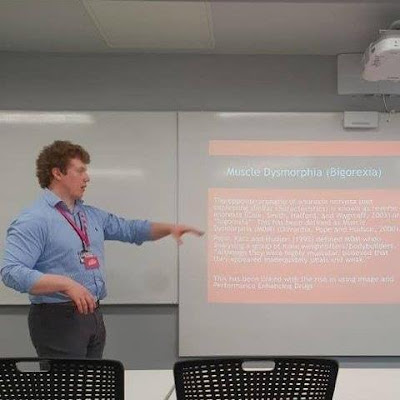

Andrew Richardson, Founder of Strength is Never a Weakness Blog

I have a BSc (Hons) in Applied Sport Science and a Merit in my MSc in Sport and Exercise Science and I passed my PGCE at Teesside University.
Now I will be commencing my PhD into "Investigating Sedentary Lifestyles of the Tees Valley" this October 2019.
I am employed by Teesside University Sport and WellBeing Department as a PT/Fitness Instructor.
My long term goal is to become a Sport Science and/or Sport and Exercise Lecturer. I am also keen to contribute to academia via continued research in a quest for new knowledge.
My most recent publications:
My passion is for Sport Science which has led to additional interests incorporating Sports Psychology, Body Dysmorphia, AAS, Doping and Strength and Conditioning.
Within these respective fields, I have a passion for Strength Training, Fitness Testing, Periodisation and Tapering.
I write for numerous websites across the UK and Ireland including my own blog Strength is Never a Weakness.

I had my own business for providing training plans for teams and athletes.
I was one of the Irish National Coaches for Powerlifting, and have attained two 3rd places at the first World University Championships,
in Belarus in July 2016.Feel free to email me or call me as I am always looking for the next challenge.
Contact details below;
Facebook: Andrew Richardson (search for)
Facebook Page: @StrengthisNeveraWeakness
Twitter: @arichie17
Instagram: @arichiepowerlifting
Snapchat: @andypowerlifter
Email: a.s.richardson@tees.ac.uk
Linkedin: https://www.linkedin.com/in/andrew-richardson-b0039278
Research Gate: https://www.researchgate.net/profile/Andrew_Richardson7


